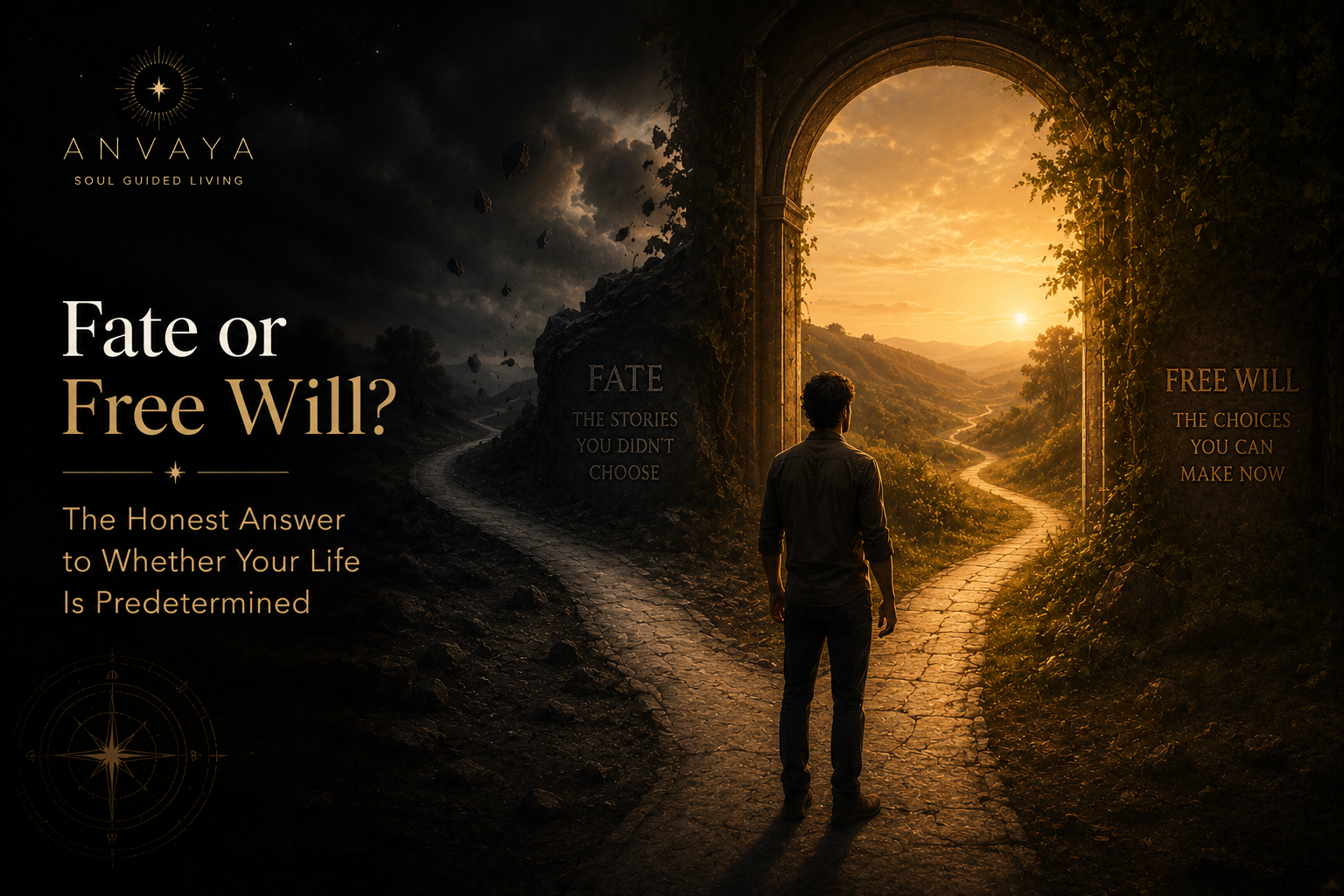
Almost everyone meets this question through pain. Something falls apart, and in the wreckage you find yourself asking: was this always going to happen? Was it written? Or did I make a choice that I could have made differently — and have to carry that?
It’s the oldest question there is, and the way it’s usually framed — fate OR free will, pick one — is exactly why it never resolves. The honest answer lives in the space the binary refuses to allow.
The false binary
Pure fate and pure free will are both, on inspection, unliveable.
If everything is predetermined, then effort is theatre, regret is cruel, and love is a script you didn’t write. Almost no one actually lives as though this were true — you still look both ways before crossing the street.
If everything is pure free will, then you must explain why lives rhyme so insistently — why patterns repeat, why timing matters, why people in nearly identical circumstances keep arriving at similar bends. Total freedom can’t account for the structure everyone secretly feels.
The truth is that you live inside both at once, and there’s a clean way to picture how.
What’s fixed and what isn’t — the river
Think of your life as a river.
The riverbed — the terrain, the gradient, the broad direction, the seasons of flood and drought — you didn’t choose. Your birth, your early circumstances, your temperament, the long cycles your life moves through: these are the given shape. Call it fate, if you like. It’s real, and pretending otherwise just makes you fight the wrong battles.
But the water — how you move through that terrain, where you pool and where you rush, what you carry and what you leave behind, the choices you make at every bend — that is entirely yours. The riverbed sets the constraints. The water writes the story.
You don’t choose the riverbed. You choose how you move through it. Both are true, and that’s the whole freedom.
Why fatalism is so seductive — and so corrosive
Fatalism offers a dark comfort: if it was all written, then nothing is your fault, and nothing requires your effort. It’s an anaesthetic. But it’s a poison too, because it quietly hands away the one thing that was actually yours — your response. People who decide everything is fixed stop steering, and then mistake the crash for proof they were right.
The opposite extreme — the belief that you control everything through sheer will — has its own cruelty. It turns every hardship into a personal failing and leaves no room for the genuine weight of a hard season that was never about your effort at all.
The freedom inside the pattern
Here’s the part that changes how you live. Knowing the shape of the riverbed doesn’t reduce your freedom — it focuses it. A sailor who understands the wind isn’t less free than one who doesn’t; they’re far more free, because they stop wasting themselves fighting what won’t move and start using it. Seeing your patterns and seasons is the same. You stop burning your agency on the fixed parts and spend it where it actually counts — your response, your timing, your next true choice.
What Vedic timing actually claims
This is precisely where an honest reading of Vedic timing sits — and where it parts ways with fortune-telling. It does not claim your future is a fixed script. It maps the riverbed: the seasons you’re moving through, where the terrain steepens, where it opens. It describes the conditions, not the choices. Two people in the same season write completely different stories, and that difference is the water — the part that was always yours.
Anvaya’s stance: orientation, not prophecy
Anvaya refuses prophecy on principle. It won’t tell you what will happen, because that would be both dishonest and disempowering. What it offers is orientation: a clear read on the terrain you’re crossing and the season you’re in, tested against your own memory so you trust it. Fate gives you the riverbed. Free will is what you do with the water. Anvaya just hands you a better map of the river — so the choices that were always yours can be made with your eyes open.